ROI-IOM Series
The ROI-IOM is the Modbus RS-485 I/O at the heart of Robert Owen monitoring systems: four inputs for 4-20 mA, 0-30 V or switch contacts, four relay outputs, an analog output, and our own Modbus RTU/ASCII firmware. Each one is configured and tested for your system – and can run custom edge calculations for a PLC.
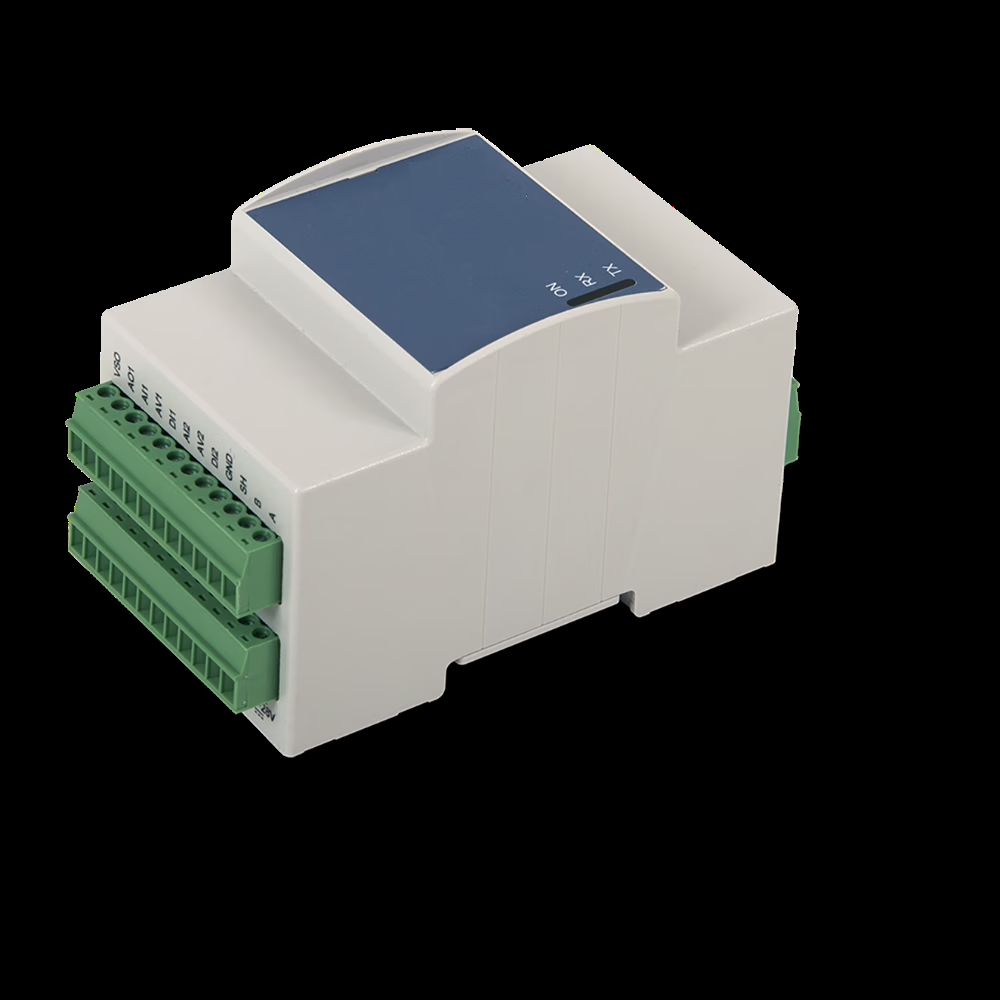
What it does in a system
Reads sensors
Four inputs in 20 mA mode (4-20 mA transmitters) or 0-30 V mode, or as digital inputs for switch contacts.
Switches things
Four relay outputs and one 0-10 V analog output for alarms, beacons, pumps or a PLC input.
Talks Modbus
Modbus RTU or ASCII on RS-485 – many modules on one cable to a PC, PLC or SCADA system.
Calculates at the edge
Custom embedded calculations, such as energy or flow, done in the module so the PLC gets the result.
Supplied as part of a Robert Owen system
The ROI-IOM ships configured and tested with the rest of your system: sensors and transmitters, the Modbus setup, and software or PLC/SCADA integration – one price for the working system.
- Inputs set to the right mode and scaled to your sensors
- Modbus address, baud rate and RTU/ASCII set for your network
- Thermocouples, RTDs and thermistors connect through our transmitters into the 20 mA inputs
- Spares and expansion for existing systems – on quote
ROI-IOM specifications
Power supply
| Parameter | Specification |
|---|---|
| Operating voltage | 12–28 V DC nominal (11–30 V DC) |
| Reverse polarity protection | 1.1 A resettable fuse, surge protection to ±500 V / 2 Ω (1.2/50 µs) |
| Current at 12 V DC | 43 mA (inputs open, relays off) to 122 mA (inputs closed, relays on) |
| Current at 24 V DC | 28 mA (inputs open, relays off) to 66 mA (inputs closed, relays on) |
| Auxiliary output VSO | VS − 1 V min., 300 mA max. |
| Auxiliary output 5VO | 5.0 V typ., 350 mA max., overcurrent protection at 420 mA |
Communication
| Parameter | Specification |
|---|---|
| Interface | RS-485 half-duplex, manual or automatic TX/RX |
| Protocol | Modbus RTU or ASCII (Robert Owen firmware) |
| Baud rate | 1200 to 115200 |
| ESD protection (A/B) | ±15 kV human body model, ±8 kV contact discharge |
| Surge protection (A/B) | ±500 V / 2 Ω (1.2/50 µs); 600 W peak pulse power at 10/1000 µs |
Analog inputs (4)
| Parameter | Current mode (AI1–AI4) | Voltage mode (AV1–AV4) |
|---|---|---|
| Range | 0–25 mA (4-20 mA) | 0–30 V |
| Input impedance | 120 Ω | > 450 kΩ |
| Converter | 12-bit SAR, 8.7 ENOB | 12-bit SAR, 8.7 ENOB |
| Sample rate | 500 kS/s max. | 500 kS/s max. |
| Max. cable length | 15 m | 15 m |
Digital inputs
| Parameter | DI1–DI4 | DI5–DI6 as 40 V inputs | DI5–DI6 as 5 V digital I/O |
|---|---|---|---|
| Input range | 0–40 V | 0–40 V | — |
| Input impedance | 49 kΩ | 6.5 kΩ | 10 kΩ pull-up to +5 V |
| Threshold high / low | 4.9 V / 3.4 V | 5.1 V / 3.4 V | 1.4 V / 1.1 V |
| Output low / high | — | — | 0.1 V / 5.0 V |
| Max. cable length | 30 m | 30 m | 10 m |
Outputs
| Parameter | Specification |
|---|---|
| Relays O1–O4 | 6 A, 250 V AC; 1500 VA resistive (AC1), 250 VA (AC15); 185 W single-phase motor at 230 V AC |
| Relay DC breaking capacity | 3 A at 30 V DC · 0.35 A at 110 V DC · 0.2 A at 220 V DC |
| Relay life | 50,000 cycles at rated AC1 load · 20,000,000 mechanical |
| Relay timing / insulation | 6 / 4 ms operate/release · 1000 V AC open contacts · 4000 V AC coil to contacts (basic) |
| Analog output AO1 | 0–10 V, 30 mA max., ±2 % of full scale max. total error, 15 m max. cable |
Environment, EMC and mechanical
| Parameter | Specification |
|---|---|
| Operating / storage temperature | −20 to +60 °C / −30 to +80 °C |
| Humidity | 5–90 % non-condensing |
| Protection | IP20 |
| EMC immunity | EN 61000-4-2, -4-3, -4-4, -4-5, -4-6, -4-8 |
| Enclosure | 3-module DIN rail, 53.5 × 90.5 × 62.0 mm, 150 g |
| Terminals | 3.81 mm pitch: up to 1.3 mm² (16 AWG), M2, 0.3 Nm, 6 mm strip · relays 5.08 mm pitch: up to 3.3 mm² (12 AWG), M3, 0.5 Nm, 7 mm strip |
ROI-IOM – common questions
Can I buy the ROI-IOM on its own?
It is supplied as part of a Robert Owen system, configured and tested for your sensors and network. Spares and expansion modules for existing systems are available on quote.
Which protocol does it use?
Modbus RTU or ASCII over half-duplex RS-485, from 1200 to 115200 baud, using Robert Owen firmware.
Can it read thermocouples or RTDs directly?
No. Thermocouples, RTDs and thermistors connect through Robert Owen transmitters into the module’s 20 mA inputs.
What power does it need?
12 to 28 V DC nominal (11 to 30 V DC), with reverse-polarity and surge protection.
Experience that scales from one sensor to hundreds
Tell us the sensors, how many, and where the readings and alarms have to go. We write our own firmware and software, so we deliver the approach that suits the project.
Questions? Contact us – we look forward to answering them.