Wireless Sensor Signal Conditioning
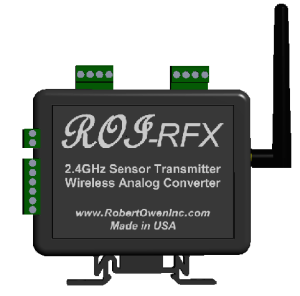
ROI-RFX wireless signal conditioners read sensors where they are and send the readings to a PC over 2.4 GHz – no cable or conduit. Each unit reads four 10K NTC thermistors or four 4-20 mA transmitters, and a pair reaches up to about a mile with the antennas in line of sight. Recording software is included with a pair.
Choose by sensor
Every unit reads four sensors of one type. A system uses at least two units: one at the sensors and one at the PC.
| Sensor | Model | Per unit | Learn more | Product |
|---|---|---|---|---|
| 10K NTC thermistor | ROI-RFX-10K | 4 thermistors | Wireless temperature monitoring | View product |
| 4-20 mA transmitter | ROI-RFX-MA | 4 transmitters | Wireless 20 mA monitoring | View product |
| Potentiometer (position) | ROI-RFX | To order | Potentiometer transmitters | Request a quote |
| Switch contacts | ROI-RFX | To order | — | Request a quote |
Prices for every wireless unit: ranges and prices →
How a wireless link works
- Wire the sensors to the sensor-end ROI-RFX – two wires per sensor or 4-20 mA loop.
- The unit conditions and converts each signal and scales it to engineering units.
- Readings travel over 2.4 GHz to the ROI-RFX at the PC – keep the antennas in line of sight.
- Watch, record and use the readings in the included ROI viewing and recording software, or live in Excel.
Power supplies for the ROI-RFX units and for 4-20 mA transmitters are not included.

Example: 4-20 mA transmitters wired to a wireless signal conditioner.
Complete wireless monitoring systems
Hardware and software together, sized to your sensors – from one remote point to many.
Wireless 4-20 mA monitoring
Remote sensor transmitters to a PC over distances up to about a mile.
4-20 mA system →Wireless temperature monitoring
10K NTC thermistors read wirelessly – four per unit, expandable.
Temperature system →Wireless sensor monitoring
Thermistors and 4-20 mA transmitters together on one wireless network.
Sensor system →Why wireless
- No cable or conduit – place the unit where the sensors are
- Obstacles stop mattering – roads, water, yards and height differences
- Simple wiring – two wires in per sensor, no polarity for thermistors
- Expandable – add units as you add measurement points
Specifications – ROI-RFX
- Radio
- 2.4 GHz, IEEE 802.15.4 (900 MHz on special order)
- Range
- Up to about 1 mile with the right antenna, line of sight
- Inputs
- 4 per unit: 10K NTC thermistors or 4-20 mA transmitters
- Output
- Readings scaled to engineering units, to a PC
- Minimum system
- 2 units (sensor end and PC end)
- Software
- ROI viewing and recording software – Lite edition, included with a pair
- Size
- 4.510 × 1.258 × 3.948 in
Wireless sensor signal conditioning – common questions
How far can a wireless sensor be from the PC?
Up to about a mile over 2.4 GHz with the right antenna, with the antennas in line of sight.
How many sensors does one unit read?
Four: either four 10K NTC thermistors or four 4-20 mA transmitters. Add units for more points.
How many units do I need?
At least two – one at the sensors and one at the PC.
What software comes with it?
ROI viewing and recording software, Lite edition, is included with a pair: channel setup, charts, digital meters, data file recording and live readings into Excel.
Can I send potentiometers or switch contacts wirelessly?
Yes, to order. Tell us the sensor and how many points.
Related
4-20 mA transmitters
Thermistor, RTD and potentiometer sensors into a PLC’s spare analog input.
4-20 mA transmitters →Sensors where the cable can’t go?
Tell us the sensors, the distance and what’s in between – we’ll size the wireless link, antennas and software.
Questions? Contact us – we look forward to answering them.