Bare Bead Thermocouples
Welded-tip thermocouples with an exposed junction for fast response, and 60-inch stripped leads that connect to any thermocouple input with a screwdriver.
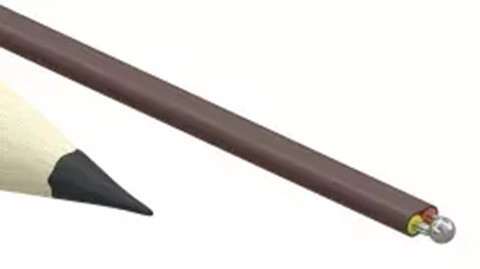
The simplest thermocouple there is
A thermocouple is two wires of different metals joined at one end. When that junction is at a different temperature from the other end, the pair produces a small voltage, a few tens of microvolts per degree, that a thermocouple input converts to temperature.
In a bare bead thermocouple the junction is a small welded bead with nothing around it: no metal sheath, no probe body, no potting. That makes it the fastest-responding and lowest-cost way to measure a point temperature.
- Exposed welded bead with very little thermal mass
- 60-inch lead, stripped at the end for screw terminals
- No connector to match: loosen a screw, insert the wire, tighten
- Extend in the field with 2-wire thermocouple extension cable and standard thermocouple connectors

At a glance
- Junction
- Exposed welded bead
- Lead length
- 60 in
- Termination
- Stripped leads
- Connection
- Screw terminal, screwdriver only
- Extension
- Matching-type 2-wire TC cable
When an exposed junction is the right choice
Good fit
- Air and gas temperature, including HVAC supply, return and discharge air
- Surface temperature, with the bead taped or bonded to the part
- Thermal profiling, where many low-cost points are spread across a product, oven or enclosure
- Short tests and troubleshooting where fast response matters
Use a sheathed probe instead
- Immersion in liquids, or anything conductive or corrosive
- Pressurized lines or process connections that need a fitting
- Locations where the bead could be bent, crushed or pulled
- Electrically live surfaces, unless the input is isolated
Common thermocouple types
The type is set by the two metals in the wire. Pick it by temperature range and environment, then set the same type on your measuring input.
| Type | Conductors (+ / −) | Typical range | Standard tolerance | ANSI colors (+ / −) | Best for |
|---|---|---|---|---|---|
| Type K | Chromel / Alumel | −200 to 1250 °C | ±2.2 °C or ±0.75% | Yellow / Red | General purpose, widest range |
| Type T | Copper / Constantan | −200 to 350 °C | ±1.0 °C or ±0.75% | Blue / Red | Low and room temperature, HVAC |
| Type J | Iron / Constantan | 0 to 750 °C | ±2.2 °C or ±0.75% | White / Red | Older equipment, reducing atmospheres |
| Type E | Chromel / Constantan | −200 to 900 °C | ±1.7 °C or ±0.5% | Purple / Red | Highest output signal |
Ranges and tolerances are for the thermocouple wire alloy (standard limits, whichever is greater). On a bare bead thermocouple the lead insulation usually sets the real maximum temperature, so tell us your highest expected temperature when you order.
Getting a good reading
- Mind the polarity. In the ANSI color code the red lead is always negative. Reversed leads read backwards as temperature changes.
- Match the extension wire. Extend only with thermocouple cable and connectors of the same type. Copper wire or a different type adds its own junction and error.
- Keep only one junction. The two wires should touch only at the bead. A second contact point along the lead moves the measurement there.
- Mount for the medium. For surfaces, tape or bond the bead flat against the part; for air, keep it out of direct contact with walls and away from radiant heat.
- Route away from noise. Thermocouple signals are microvolts. Keep leads clear of motor and power wiring.
Why the input matters too
A thermocouple measures the difference between the bead and the point where its wires land on copper terminals. The measuring input has to know that terminal temperature, called cold junction compensation, to report the true bead temperature. Use an input built for thermocouples, set to the matching type.
Ready for your measurement system

Log to a laptop over USB
Screw the leads into a USB thermocouple data acquisition unit, plug it into a laptop and record. A portable setup for testing and thermal profiling.
USB thermocouple data acquisition →Any standard thermocouple input
Stripped leads land on any screw-terminal thermocouple input: data loggers, controllers, PLC thermocouple cards and signal conditioners. Robert Owen can also build the complete measurement chain, from sensor to software.
Ask about your system →Order bare bead thermocouples
Tell us the thermocouple type, quantity and the highest temperature you expect, and we’ll quote the right sensor.