Beaded Type T Thermocouple
An exposed welded-bead Type T thermocouple for fast, accurate air and surface temperature readings near room temperature. Stripped leads connect to any thermocouple input with a screwdriver.
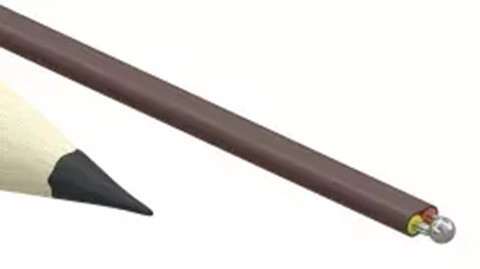
Small bead, fast response
The BW-T-B3 is a Type T thermocouple with its junction welded into a small bead at the tip. The two conductors are split for the last 5/8 inch, so the bead sits clear of the cable and responds to the air or surface it touches rather than to the lead.
At the other end, 2 inches of stripped wire land directly on screw terminals. There is no plug to match: loosen a screw, insert the wire, tighten.
- Exposed welded bead with very little thermal mass
- Type T: copper / constantan, the most accurate common type at low and room temperatures
- 3 ft total length; extend in the field with Type T extension cable and connectors
BW-T-B3 specifications
- Part number
- BW-T-B3
- Type
- T (copper / constantan)
- Junction
- Exposed welded bead
- Tip split
- 5/8 in
- Stripped leads
- 2 in
- Total length
- 3 ft
- Polarity
- Blue = + (copper), Red = − (constantan)
- Output
- Nonlinear mV; needs cold junction compensation
The right type for ambient, HVAC and lab temperatures
Accurate where it matters
Standard tolerance is ±1.0 °C or ±0.75%, whichever is greater, tighter than Types J and K in the room-temperature range.
Works below zero
The Type T alloy covers −200 to 350 °C, so freezers, cold rooms and chilled air are in range as well as ambient.
Stable copper leg
The positive conductor is copper, which resists drift in moist and mildly oxidizing air.
Ranges are for the thermocouple alloy. On a bare bead sensor the lead insulation usually sets the real maximum temperature; tell us your highest expected temperature when you order.
Where the beaded T fits
Ambient air
Room, enclosure and test-chamber temperature.
HVAC
Supply, return and discharge air, where fast response matters.
Surface temperature
Bead taped or bonded flat to a pipe, heat sink or part.
Cold storage
Freezers, coolers and chilled-air checks below 0 °C.
For liquids, pressurized lines or anything that could bend or crush the bead, use a sheathed probe instead. See bare bead thermocouples for a full comparison.
Getting a good reading
- Mind the polarity. Blue (copper) to +, red (constantan) to −. Reversed leads read backwards as temperature changes.
- Set the input to Type T. The input must use the Type T curve and its own cold junction compensation.
- Extend with Type T wire only. Copper hook-up wire or another type adds a junction and an error.
- Keep the leads quiet. The signal is about 40 µV per °C near room temperature; route it away from motor and power wiring.
Why cold junction compensation?
A thermocouple measures the difference between the bead and the terminals its wires land on. The input measures the terminal temperature and adds it back, using the Type T reference table, to report the true bead temperature.
NIST ITS-90 Type T coefficients →Ready for your measurement system

Log to a laptop over USB
Screw the leads into a USB thermocouple data acquisition unit, plug it into a laptop and record. A portable setup for testing and thermal profiling.
USB thermocouple data acquisition →Add it to a PLC
A DIN-rail thermocouple transmitter handles cold junction compensation and linearization, and sends a 4-20 mA temperature signal to a PLC or controller.
DIN thermocouple transmitters →Order the BW-T-B3
Tell us the quantity and the highest temperature you expect, and we’ll quote the beaded Type T thermocouple or a longer-lead version.